
|
Greece at the Benaki Museum |
Greece at the Benaki Museum
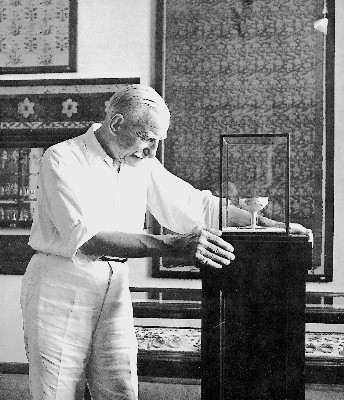
The motive force inherent in the contents of the museum collections, combined with the growth of the museum’s activities, indicate the special character of the institution and allow one to appreciate its integral nature, which arises out of the absolute consistency existing between the conception and the implementation of a causal idea: the revelation of the lineaments of Hellenism, or rather of that inner coherence which permeates its apparently disparate outer features, in such a way as to re-establish the course of its historical passage through the centuries.
It begins with the introductory prehistoric and early historic displays, with astonishing creations of the Mycenaean period, to the abstract expressionism of the Geometric Age, to an understanding of the orientalizing 7th century BC, to the exhilarating charms of 6th-century BC archaic art. The classical period of the 5th and 4th centuries BC is represented by humbler works, that nonetheless allow one to follow with ease the process of development up to the years of the Hellenistic period when Hellenism became diffused and debilitated, while the Romans simultaneously consolidated their ascendancy. The thread of continuity runs through the safeguarding during the years of Roman dominance of the Greek heritage in a sequence of dramatic transformations that edified the art of Byzantium, which endured for a thousand years. The post-Byzantine collections of ecclesiastical and secular art cover the historical period from the 15th to the 19th centuries, and are evidence of the high level of culture enjoyed among later Greeks in the course of Frankish and Ottoman occupation. Finally, the collections of relics of the War of Independence (1821) indissolubly linked with all the other material, confirm the close relationship that exist between the low and high points of events. The same applies to objects dating to King Othon’s reign (1832-1862) and mementos of Eleftherios Venizelos (1864-1936) and of the Asia Minor disaster (1922).
The collections of the Benaki Museum, focusing upon the Byzantine, post-Byzantine and later periods of Hellenism, mark geographically the expanding and contracting boundaries of Greek lands, chronologically the fluctuations of their historical development, and culturally their relationship with neighbouring peoples. They were assembled in such a way as to constitute as complete a grouping as possible.
© 1998 Oxfordshire Museum Service,
Setúbal Museums and the Benaki Museum
