
|
|
Handled Comb of Antler from Barton Court Farm, Abingdon, Oxfordshire: 6th to 8th centuries AD |
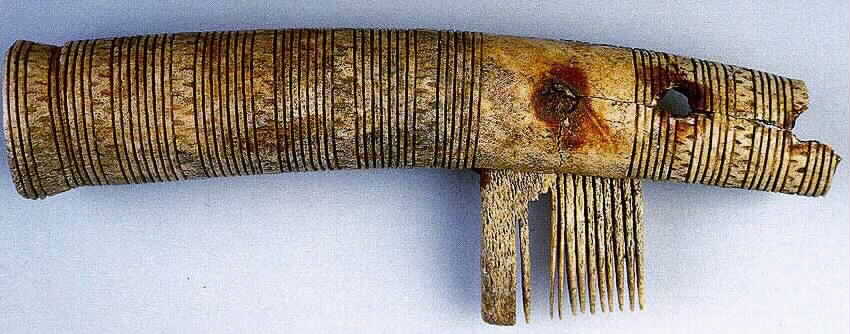
During the 5th and 6th centuries, a small Saxon community re-occupied the late Romano-British farmhouse villa site at Barton Court Farm, re-using the rooms of the ruinous villa, digging sunken-floor huts in the enclosure, and discarding possessions into the silted up enclosure ditches. This comb must have been one of the very last items to have been lost.
All ten of the bone combs found at Barton Court Farm were of the Saxon period and, judging by the relatively small size, delicate construction and numerous teeth, all were for combing hair. The decorative design of these combs indicates the importance attached to combing hair, and the survival of so many suggests frequency of use.
The comb is made of an antler along which a long narrow slot has been cut to receive the tooth plates, which originally numbered twelve and were attached by metal rivets. The natural shape of the antler has been utilised to create a tool which would have been simple to control, following the curve of the skull and able to part and style the hair, as the comb probably originally tapered to a point. A close study of the comb shows that the individual teeth were cut after the attachment of the plates, and that one user probably always held the comb with the same hand, as all the wear is on one side of the teeth.
Combs of this style are usually dated to the 8th century or later, being typical of goods from the Rhineland which were brought to England by 8th-century merchants from Frisia in the Netherlands, or Scandinavian combs arriving with the Vikings in the 9th century.
© 1998 Oxfordshire Museum Service,
Setúbal Museums and the Benaki Museum
